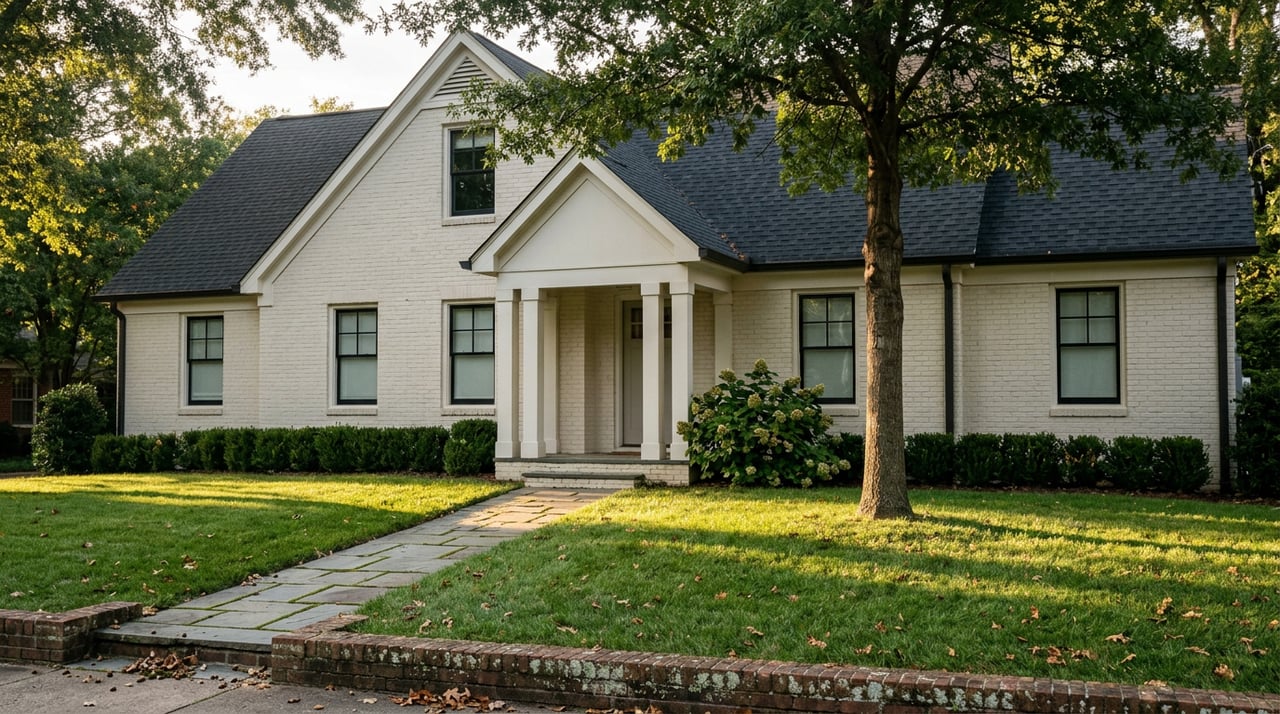
Inside the Beltline Raleigh Teardowns and the Zoning Divide
September 24, 2026
A Forest Park resident recently called what's happening on his street a "shame" and a "waste," describing the pace of demolitions to a local reporter as something that felt less like progress and more like his neighborhood disappearing one lot at a time. He isn't wrong about the pace. Raleigh's own demolition permit records show 105 residential teardowns in 2023, 124 in 2024, and 252 in 2025, a jump that outstrips almost anything else happening in the city's housing market right now.
For buyers, an important consideration is that zoning and historic-overlay rules vary across Inside the Beltline. Inside the Beltline isn't one market with one trajectory. It's two different sets of economics running on the same street grid, and which one applies to a given block depends on a zoning designation that has nothing to do with square footage, curb appeal, or even the neighborhood name on the sign.
In 2021 and 2022, Raleigh City Council passed a pair of ordinances, known locally as TC-5-20 and TC-20-21, that removed the density cap in nearly every residential zoning district except one and opened the door to duplexes, townhomes, and small apartment buildings in areas that had allowed only detached single-family homes for decades. The policy goal was more housing supply. The side effect, three years later, is a math problem that any builder can solve in an afternoon.
Raleigh's planning director told local reporters that new single-family homes going up inside the Beltline are commonly listing between $1 million and $1.1 million. Two-unit townhomes built on that same lot, by contrast, are selling for roughly $550,000 to $700,000 per unit. Multiply that out and a builder who replaces one aging house with two front doors can clear more total revenue than building one larger house, without needing the lot to be any bigger. That gap is the actual driver behind the demolition numbers, more than any single narrative about demand or gentrification. When the zoning allows it and the math favors it, the bungalow comes down.
This is not happening evenly. It's concentrated on streets where the zoning allows it and nothing else stands in the way.
Two of the Beltline's best-known historic neighborhoods, Hayes Barton and Oakwood, carry local historic overlay designations. That status doesn't freeze prices or block sales, but it does insert a real procedural gate. That gate has been tested directly. WUNC reported that a developer's plan to replace a single house on Williamson Drive in Hayes Barton with 17 townhomes has been in and out of Wake County Superior Court and the North Carolina Court of Appeals since 2023, with neighbors arguing the underlying Missing Middle ordinances should have gone through a full rezoning process rather than a simpler text change. In December 2025, the Court of Appeals dismissed the neighbors' request to halt construction while the larger case proceeds, but it explicitly allowed the broader challenge to Raleigh's zoning reform to continue in the trial court. A second, similar case involving a 16-unit townhome proposal near Raleigh Country Club is working through the same court system with the same attorney representing the neighbors in both.
None of that litigation is really about Hayes Barton's zoning surviving or failing. It's about whether the historic overlay process gives a neighborhood real leverage to slow or reshape a project, or just delay it. So far, the record suggests delay: Raleigh Forward reported that, after the initial court ruling, the Williamson Drive developer filed an amended plan, trimmed to 17 townhomes from 18, and the city approved it in April 2025. The overlay didn't stop the redevelopment. It changed its shape and its timeline.
Compare that to blocks in Cameron Park, Bloomsbury, or College Park, where there is no blanket historic overlay standing between a for-sale sign and a demolition permit. Local descriptions of these neighborhoods consistently note more flexibility for expansions and full rebuilds, and more visible teardown-and-infill activity, because the same zoning math applies without the extra procedural step.
Mordecai sits in between. Realtor Jacquelyn Raynor, who works the neighborhood, has described a mix of both patterns on the ground: some lots getting torn down and rebuilt, but more owners choosing to remodel and keep the original character of the older houses. That's not a zoning protection so much as a local preference, which means it can shift lot by lot depending on who's selling and who's buying.
Here's where the mechanism shows up in pricing, not just permits. A recent third-party estimate placed the broad Inside-the-Beltline median sale price near $750,000 for the first quarter of 2026, well above Raleigh's citywide median, which sat around $450,000 to $465,000 in early 2026. That broad figure does not capture the full range of factors behind the ITB premium; walkability and proximity to downtown explain only part of the gap.
Location isn't the whole story. Current listings put Mordecai's typical single-family asking price in the low $800,000s, on par with Oakwood and meaningfully above the citywide figure. Part of that premium is location. Part of it is scarcity created by the overlay itself, which supports the price of the existing single-family stock even as the rest of the Beltline diversifies into townhomes and smaller-footprint new construction.
Meanwhile, the city's planning director reported to council in mid-2024 that the Missing Middle policy had already produced more than 2,800 new housing units since 2021, the large majority of them townhomes, with a much smaller number of duplexes and accessory dwelling units. Given how the demolition count kept climbing through 2025, that figure almost certainly undercounts where things stand today. That supply is landing disproportionately on blocks without overlay protection, which is why a buyer comparing two ITB streets with similar 2026 asking prices can be looking at two different five-year streetscape possibilities: one where the surrounding block may remain largely single-family, and one where townhomes and other infill may become more common.
If you're comparing pockets inside the Beltline, the median price on a portal listing tells you almost nothing about which of these two economics you're buying into. A few things will tell you more:
None of this makes one type of block better than another. A buyer who wants stability and is willing to pay for it has good reasons to look at Hayes Barton or Oakwood. A buyer looking for more building flexibility, or comfortable with a changing streetscape, has real options in Cameron Park, Bloomsbury, or College Park at a different price point. What matters is knowing which economics apply to your specific lot before you're comparing it to a citywide median that was never built to capture this split in the first place.
If you're weighing a purchase or a sale anywhere inside the Beltline and want a read on how a specific block's zoning history and overlay status might affect your options, I'm happy to walk through it with you. You can see more on Raleigh neighborhoods or reach out directly through Nev Nelson. Let's Connect.
This article is general information, not legal, tax or financial advice. Consult a qualified professional about your situation.
Stay up to date on the latest real estate trends.
Whether you are a first-time buyer, a seasoned investor, or somewhere in between, I bring Raleigh / Triangle market knowledge and personal attention that make all the difference. I take time to understand your goals and tailor every step of the process to fit your needs. From strategy to closing, I ensure you feel confident and well-informed throughout your real estate journey.
Nev Nelson
201 Commonwealth Court, Suite 100 Cary, NC 27511