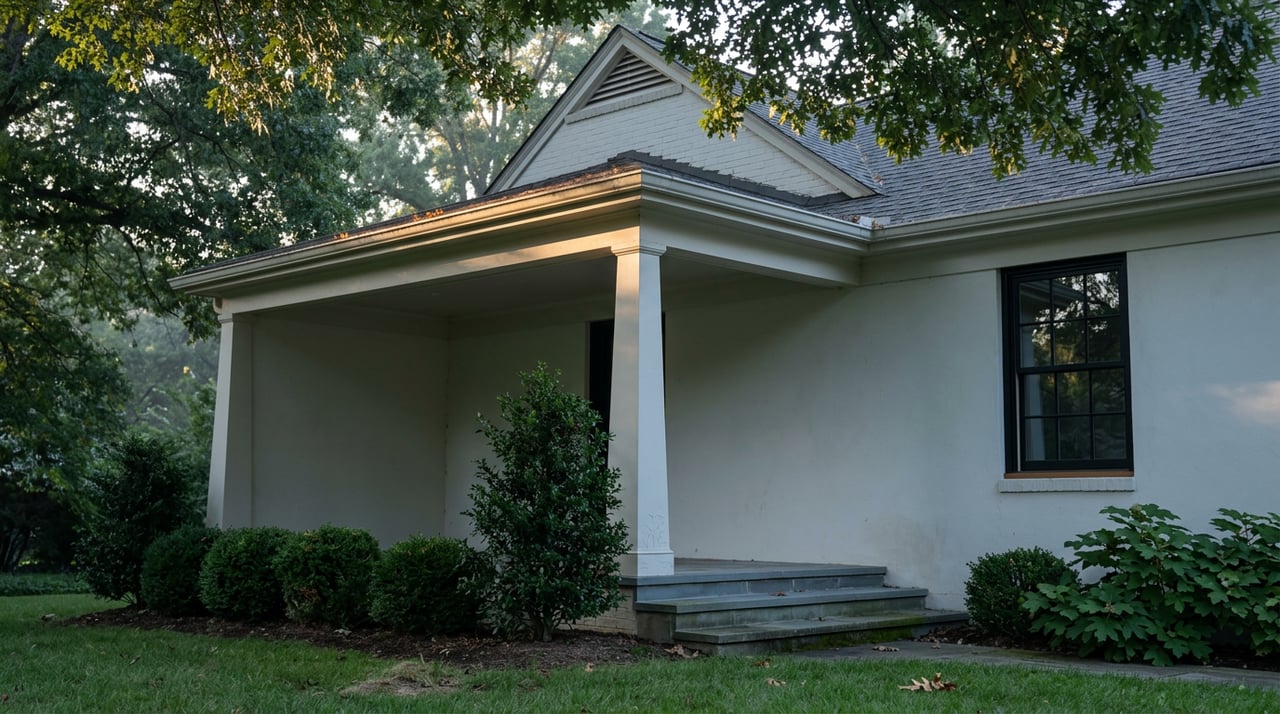
Durham Froze Every Tax Value in January 2025: Your Neighborhood Didn't Get the Memo
September 3, 2026
September 3, 2026
"I really was surprised. Things have appreciated in this neighborhood faster than I was expecting," Durham homeowner Lee Galbreath told a local TV crew after opening his 2025 reappraisal notice. He wasn't alone. Durham County mailed new assessed values to every property owner that spring, and thousands of residents got a number that looked nothing like what they'd budgeted for.
Here's what almost none of that coverage mentioned. The number in that envelope wasn't a snapshot of the market today. It was a snapshot of the market as of January 1, 2025, and by law it stays frozen at that value until the next countywide reappraisal in 2029. That single fact matters more to someone shopping for a home in Durham right now than the median price on any listing. Two neighborhoods can show the exact same asking price this month and carry completely different tax stories, because one of them has kept climbing since that January snapshot and the other has already turned around and started falling.
To understand why the 2025 numbers landed so hard, it helps to know what they were catching up to. Durham County's last general reappraisal before this one took effect in 2019. Between then and January 2025, the county said the new values reflect the full change in market value across that entire six-year window. County-level median sale prices moved from roughly $239,500 in January 2019 to about $416,000 by December 2024, and the county's own tax administrator told commissioners that the average Durham home going into the reappraisal was assessed for less than two-thirds of what it could actually fetch on the open market, the widest gap of any county in the Triangle.
That gap is what produced the sticker shock. It's also why more than 10,000 property owners filed formal appeals in 2025, an unusually high volume for a jurisdiction of Durham's size. The county's own guidance is blunt about what an appeal has to prove going forward: any evidence you bring, whether it's a comparable sale, a fee appraisal, or a refinance document, has to speak to what the property was worth on January 1, 2025. A contract you sign this fall for more, or less, than that number doesn't move the needle on your tax bill. It can't, until 2029.
Durham did what most counties do after a reappraisal. It lowered the tax rate. The countywide rate dropped from 79.87 cents per $100 of assessed value to 55.42 cents, and the City of Durham set its own rate at 43.71 cents, for a combined rate of $0.9913 per $100 for the 2025-2026 fiscal year, according to the county's own Neighborhood Compass tool. That combined rate rose slightly for fiscal year 2026-2027, when county commissioners approved a 2.5-cent increase to the countywide portion, bringing it to 57.92 cents, while the city held its rate flat at 43.71 cents. Add those together and a Durham homeowner is paying $1.0163 per $100 of assessed value this year, up from $0.9913 the year before.
Here's the part that trips people up. A revenue-neutral rate is calculated to produce the same total tax revenue countywide, on average, as the old rate did before the reappraisal. It says nothing about any individual property. If your specific block appreciated faster than the county as a whole, your tax bill goes up in real terms even though the rate went down. If your block appreciated slower, or fell, your bill can drop even as the rate creeps back up in later years. The rate is a countywide average. Your neighborhood is not.
| Fiscal Year | County Rate | City Rate | Combined Rate per $100 |
|---|---|---|---|
| 2025-2026 | 55.42 cents | 43.71 cents | 99.13 cents |
| 2026-2027 | 57.92 cents | 43.71 cents | 101.63 cents |
This is where the reappraisal freeze stops being an abstract legal detail and starts changing what a specific offer actually costs you over time.
Take Northgate Park, the neighborhood built around the city park of the same name in north Durham. As of February 2026, homes there sold for a median of $333,000, down 13.3 percent from a year earlier, with the typical listing going under contract in 22 days compared with 114 days the year before. That's a small sample, only 11 sales that month, but it points to a neighborhood whose current market has already cooled well below whatever number the January 2025 snapshot locked in. A buyer closing there today may be paying less than the assessed value implies, which is worth knowing before you assume your tax bill will simply track your purchase price.
Now compare that to Forest Hills, the 1920s-era neighborhood southeast of downtown known for curving streets and larger lots around Forest Hills Park. As of March 2026, its median sale price sat near $792,500, but only two homes sold there that month, which means that median is really describing a handful of transactions rather than a deep, liquid market. Thin volume like that cuts both ways for a buyer. It means less competition on any single listing, but it also means you have very little recent comparable-sale evidence to lean on if you ever need to challenge an assessed value.
Then there's Hope Valley, Durham's original country club neighborhood, anchored by a Donald Ross-designed golf course and built out mostly between 1927 and 1959. As of that same March 2026 window, its median sale price sat around $452,500 with a typical 73 days on market, but that median hides an enormous spread. Recent sales there have ranged from $247,000 to $1.35 million. A neighborhood-level median is nearly meaningless in Hope Valley on its own. What matters is which decade a given block was built in, how much it's been renovated, and where on that spectrum a specific house actually sits, none of which shows up in a single headline number.
Three neighborhoods, three completely different relationships between what the market is doing right now and what the January 2025 snapshot assumed. None of them are wrong. They're just not comparable using a citywide median.
There's one more piece of this freeze that catches new-construction buyers off guard. If a builder puts a house on a lot that was vacant on January 1, 2025, the county still appraises that new home using January 2025 market values, not today's construction costs or today's comparable sales. That means a brand-new build finished in 2026 or 2027 can carry an assessed value based on a market snapshot from before it even existed. For a buyer comparing a new build to a resale in the same pocket of Durham, that's a real variable, not a rounding error.
If you're weighing two Durham neighborhoods against each other this fall, the sale price on the listing sheet only tells part of the story. Before you compare two homes on price alone:
If I pay more than the assessed value, will my tax bill go up to match my purchase price? No. Under North Carolina law, the assessed value stays fixed at the January 1, 2025 reappraisal date until the next general reappraisal in 2029, aside from a few narrow exceptions like new construction or a change in zoning.
Can I appeal my assessed value based on what I actually paid for the home? You can bring your purchase price as evidence, but the Board of Equalization and Review will weigh it against what the property was worth on January 1, 2025, not today. A single recent sale isn't automatically treated as proof of that earlier value.
When is Durham County's next reappraisal? January 1, 2029, based on the county's current four-year cycle, which is shorter than the eight-year minimum North Carolina law requires.
If you're trying to figure out how a specific Durham block or a specific new-construction lot fits into this picture before you write an offer, that's exactly the kind of question worth a real conversation rather than a portal search. Nev Nelson works these tax and timing details into every Durham comparison for buyers weighing neighborhoods against each other, not just prices against each other. Let's Connect.
Stay up to date on the latest real estate trends.
Whether you are a first-time buyer, a seasoned investor, or somewhere in between, I bring Raleigh / Triangle market knowledge and personal attention that make all the difference. I take time to understand your goals and tailor every step of the process to fit your needs. From strategy to closing, I ensure you feel confident and well-informed throughout your real estate journey.
Nev Nelson
201 Commonwealth Court, Suite 100 Cary, NC 27511